Background
To understand whether artificial intelligence causes deskilling in education, it is necessary to examine earlier learning tools, define core concepts, and understand why AI may differ from previous technologies.
Historical Background
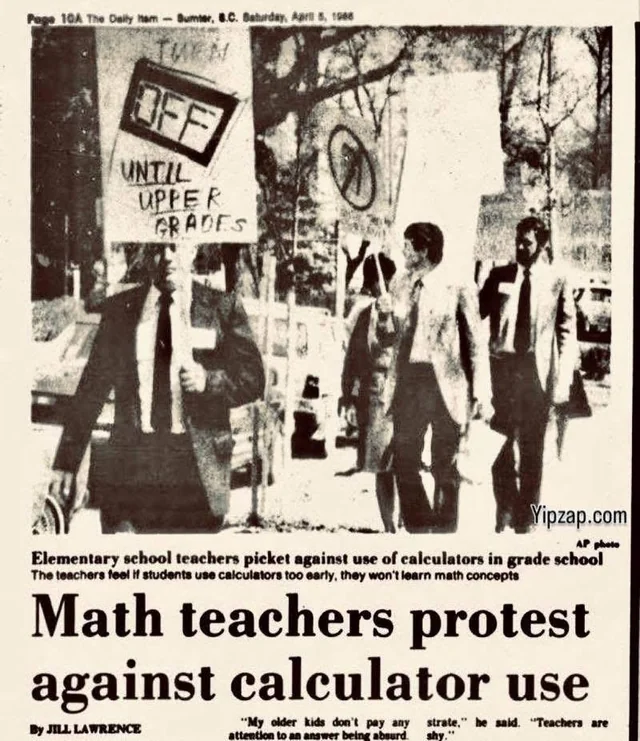
Technology has always changed classrooms.
The fear of the risks technology poses on classrooms is not a recent development. In the 1980s, concerns of the graphing calculator made appearances in protests.
Will LLMs in the classroom will have the same rewarding results?
Why AI Is Different
Earlier tools, like calculators, helped students complete narrow tasks. AI tools can now generate essays, explain readings, solve equations, summarize chapters, write code, and imitate expert language.
Because AI can perform broader cognitive labor, the historical success of calculators does not automatically guarantee similar outcomes for AI.
Important Key Terms
Defining Deskilling
Deskilling occurs when overusage of technology reduces existing skills or hinders the formation of skills.
Defining Cognitive Offloading
Cognitive offloading is the practice of using outside tools to take on some of the brain’s workload.
Defining Skill Erosion
Skill erosion occurs when previously developed skills weaken over time because they are not regularly practiced or are replaced by external tools. Unlike deskilling, skill erosion refers to the long-term, incremental decline that may happen.