Research
The purpose of our research is to answer our central question: does AI in education support learning, or does repeated reliance on AI weaken the skills students are supposed to develop?
Methodology
Our team used a meta-study approach, reviewing historical research, recent studies about generative AI, cognitive offloading, writing patterns, critical thinking, hallucinated citations, and more. We looked for recurring patterns across sources rather than relying on one study alone.
Because long-term educational AI data is still limited, our analysis focuses on early evidence, correlations, and repeated themes across current research.
Key Studies
AI use, offloading, and critical thinking
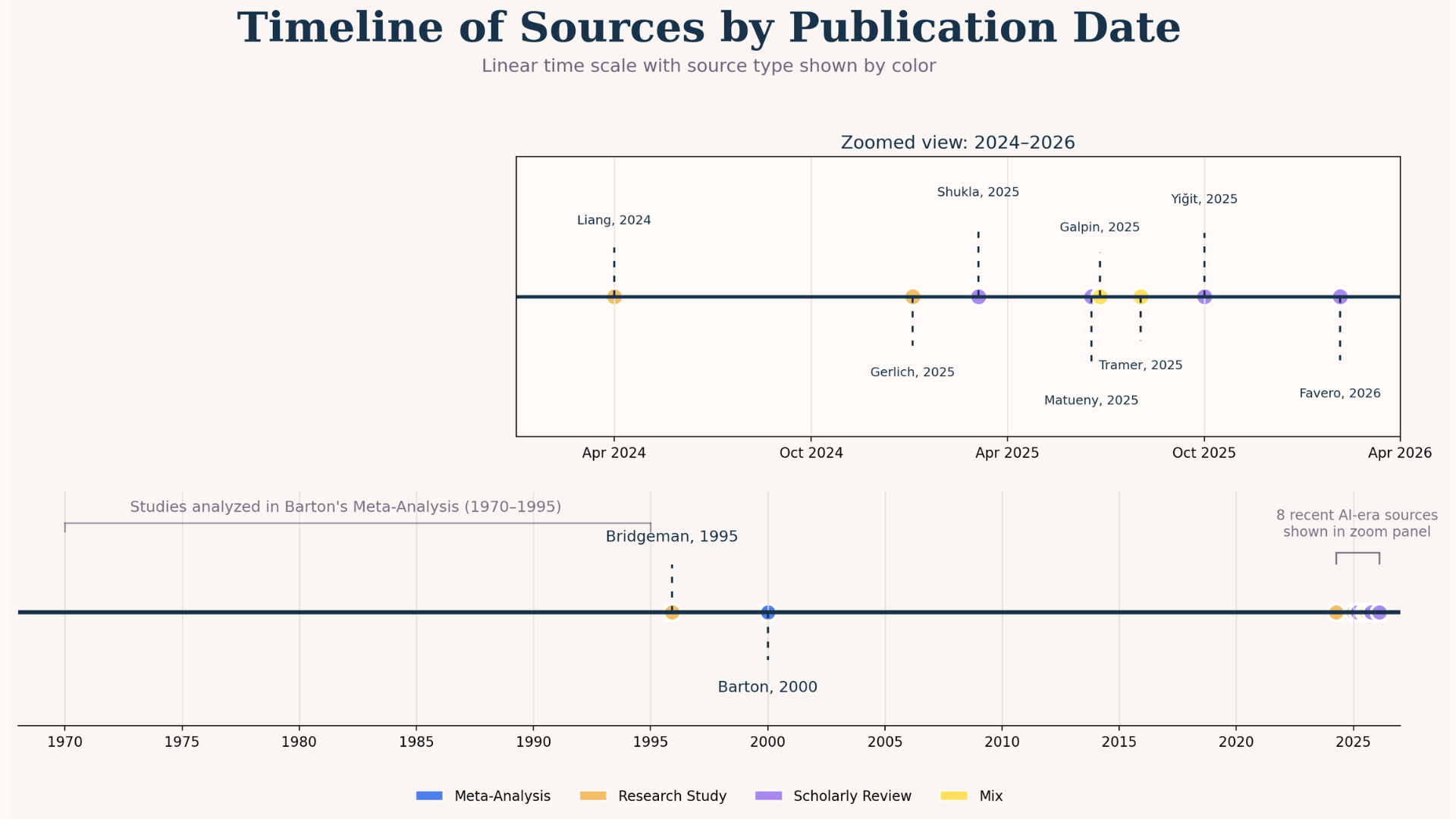
Matueny and Nyamai describe how AI use can create an illusion of understanding. Users may feel confident in material they did not fully process, contributing to long-term skill degradation.
Scientific language is shifting
Galpin et al. found that AI influence appears in whole clusters of stylistic words, not just isolated terms. This supports the idea that AI can shape writing norms and make academic language more homogeneous.
Beyond learning outcomes
Favero et al. argue that AI in education affects not just performance, but cognition, agency, and emotional engagement.
Key Quotes
“Scientific English is undergoing unprecedented language change. Our observations indicate that these changes are not limited to individual lexical entries but extend to entire lexical groups.”
“Despite AI’s perceived benefits, UX practitioners overwhelmingly agree that AI cannot fully replace human cognition, but rather serves as a complement to human expertise.”
“Ultimately, an ethical use of AI in education is about preserving education as a space for autonomy, critical inquiry, and democratic formation.”
Timeline of Sources